
I remember standing on the sidewalk outside my first little shop, staring at my phone and feeling my heart sink into my boots. I was standing exactly ten feet from my own front door, yet when I searched for my services, my business was nowhere to be found on the map. It felt like I was wearing a digital invisibility cloak that I never asked for, while the guy three blocks over—who I knew for a fact didn’t have my level of expertise—was hogging the top spot. If you have ever stood in your own lobby, searched for your primary service, and felt like a total stranger to the algorithm, I want you to know you aren’t alone. It is a gut-punch, but it is rarely because your business isn’t ‘good enough.’ It is usually because the map is playing by a set of rules you haven’t been invited to yet. Today, we are going to peel back that curtain and fix the disconnect between your physical door and your digital one. Have you ever checked your own listing only to realize your competitors are stealing the spotlight right from under your nose?
Your Map Pin is Basically a Ghost to Local Searchers
Most of us treat our map listing like a set-it-and-forget-it billboard, but that is a mistake I paid for dearly in my early days. I honestly thought that just having a pin meant I was in the game. I was wrong. Mobile searchers are moving fast; they are usually driving, walking, or multitasking, and they have zero patience for a listing that looks incomplete or uninviting. If your profile doesn’t immediately scream ‘I am open, I am reliable, and I am right here,’ they will skip you in a heartbeat. This is exactly where many local SEO optimization plans forget about mobile users and their specific, high-intent needs. It is not just about appearing on the map; it is about being the most helpful answer to a 3:00 PM problem. According to a landmark study by BrightLocal, a staggering 98% of consumers read online reviews for local businesses, and if your mobile presence lacks that immediate social proof or shows conflicting data, you are essentially handing your customers to the competition on a silver platter.
Will spending time on these maps actually bring people through my door?
I get it. You are incredibly busy running the actual operations of your business, and the idea of ‘optimizing’ another digital profile feels like a chore that might not even move the needle. You might be skeptical if this is all just technical smoke and mirrors. I used to think the same thing until I realized that my local listing win was never going to happen by accident. I once spent three months wondering why my foot traffic had dipped, only to realize I had a duplicate listing with a phone number that lead to a dead line—a silly, avoidable mistake that cost me thousands in potential revenue. We are going to dive into local pack improvement strategies that outperform competitors by focusing on the tiny, human details that make a mobile searcher stop scrolling and start driving toward you. We are not just chasing abstract rankings; we are chasing neighbors who are ready to walk through your door right now. To truly climb higher in the map pack, you have to stop thinking like a marketer and start thinking like a hungry customer with a dying phone battery.
Stop Letting One Wrong Category Choice Sink Your Visibility
The absolute first thing you need to audit is your primary category. Think of your primary category as the aisle in a supermarket where your business lives. If you are selling specialized organic dog treats but you have listed yourself under ‘General Grocery,’ you are competing with giants you cannot beat and missing the people looking for exactly what you offer. I once worked with a boutique owner who used ‘Clothing Store’ as her primary tag. She was struggling to get any traction until we realized she exclusively sold high-end vintage bridal wear. The moment we changed her category to ‘Bridal Shop,’ her phone started ringing within 48 hours. This is why your primary category is destroying your map pack placement if it is too broad or just slightly off-center. You need to be a laser, not a floodlight in the world of local business maps.
Fix Your Address Data Before the Algorithm Punishes You
Your NAP—Name, Address, and Phone number—is essentially your digital fingerprint. If even one digit of that fingerprint is smeared across the web, the algorithm starts to distrust your location. Imagine trying to find a friend’s house but three different people give you three slightly different addresses; eventually, you will just stop looking. This is why you must learn how to fix incorrect address data for a local listing win. I remember a client who could not break into the top three for months because an old Yelp listing from five years ago still had ‘Suite B’ instead of ‘Suite 200.’ To the machines that run local search, those are two different places. Clean, consistent data is the boring but mandatory price of admission for long-term map pack success.
Turn Your Camera Into a Ranking Machine
Static profiles are dead profiles. If your photos look like they were taken on a flip phone in 2005, customers will assume your service is just as outdated. But it is not just about aesthetics; it is about context. Google’s AI is incredibly good at ‘reading’ images. When a customer uploads a photo of your signature dish or your tidy storefront, the algorithm scans it to confirm you are who you say you are. This is how local business maps use customer photos to rank you. I make it a habit to upload one new, high-resolution photo every single week. It signals to the platform that the lights are on and someone is home, providing the fresh content needed for local pack improvement.

Engagement is the Pulse of a Successful Listing
Reviews are the lifeblood of the map pack, but most owners only care about the star rating. The real secret is the dialogue. When you respond to a review—even the bad ones—you are telling the search engine that you are active and customer-focused. This level of active management is a core part of any local listing win. Every time you reply, you have an opportunity to naturally use keywords that relate to your service. I have seen businesses jump two spots in the rankings simply by clearing a backlog of unanswered reviews. It is a direct signal of reliability, and it is why responding to every review leads to a local listing win. Don’t just collect stars; build a conversation that proves you are the most relevant authority in your neighborhood.
Stop Obsessing Over Directory Quantity
Everyone tells you that the key to a local listing win is getting your business on every obscure directory from here to Timbuktu. But here is a contrarian truth: most of those directories are useless. In my years of troubleshooting stalled rankings, I have seen businesses with 300 citations lose to competitors with only 20 high-quality, relevant ones. According to the Whitespark Local Search Ranking Factors study, the influence of citations has steadily declined as Google’s AI gets better at identifying real entities through user behavior and localized website authority. This is the truth about local pack improvement and citations that many ‘old school’ marketers still refuse to accept. If you are spending hours every month on low-tier directories, you are literally wasting your most valuable asset—your time.
The Keyword Stuffing Trap That Leads to Sudden Ghosting
There is a massive ‘oops’ factor I see all the time: the temptation to stuff your business name with keywords. You think, ‘If I just change my name on the map to Bob’s Plumbers—Best Emergency Drain Cleaning in Chicago, I’ll rank better.’ And for a week, you might. But this is a dangerous trap. Google is cracking down on name manipulation, and a manual suspension is a nightmare to recover from. This is why your business name affects your local listing win in ways that can either build your future or burn it down overnight. Authentic branding always wins in the long run because it builds trust with both the algorithm and the human beings looking at their screens.
Why being the closest option isn’t always enough to rank?
You might assume that if a searcher is standing in your parking lot, you are a lock for the top spot. Not necessarily. The logic behind modern map pack placement has evolved beyond simple proximity. Google now heavily weighs ‘prominence’ and ‘relevance.’ If a competitor half a mile away has a significantly higher click-through rate (CTR) and more frequent engagement, they can easily hop over you. There is the real connection between CTR and map pack success; the algorithm interprets those clicks as a vote of confidence. It assumes that if people keep choosing the shop down the street over yours, that shop must be the better answer. To beat them, you need local pack improvement strategies that outperform competitors by making your listing irresistible to the eye, not just physically close.
Master the Complexity of Multi-Area Service
One of the most sophisticated hurdles for growing businesses is learning how to scale map pack success across multiple service areas without looking like a spam bot. The common mistake? Creating ‘ghost offices’ or using P.O. boxes. Google’s verification systems are smarter than your average VPN. If you want to dominate a whole region, you have to build genuine local authority for each hub. Have you ever fallen into the trap of thinking a bigger ‘radius’ in your settings would magically bring in more calls? Let me know in the comments, and let’s figure out how to fix it together.
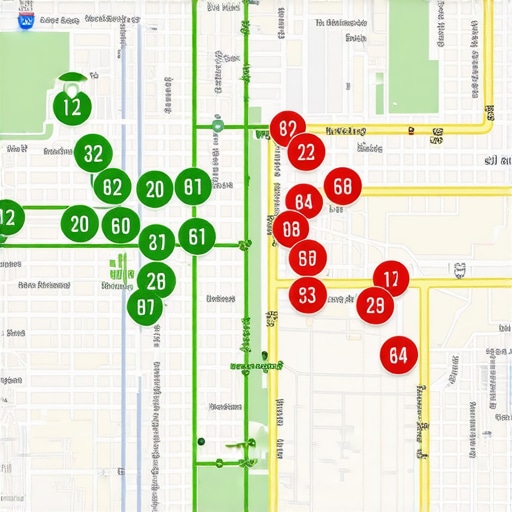
I’ve spent countless late nights wondering if my hard work would just vanish into the digital ether the moment I stopped looking. The truth is, achieving a local listing win is only half the battle; staying there is where the real professionals separate themselves from the amateurs. If you aren’t checking your performance regularly, you’re essentially flying blind. I personally use Local Falcon to run geogrid reports once a week. Why? Because ranking #1 while sitting at your office desk doesn’t mean you’re ranking #1 three miles away at a busy intersection. As Joy Hawkins, a leading voice at Sterling Sky, often points out, proximity is a fluid metric that changes based on local competition and searcher intent. Using a grid view is the only way to see the actual ‘holes’ in your visibility. This is how to monitor your map pack placement progress effectively without losing your mind.
How do I keep my rankings steady without working forty hours a week on them?
The secret isn’t a one-time fix; it’s a specific rhythm. I call it the ‘Five-Minute Maintenance Rule.’ Every Monday morning, I check for suggested edits on my profile. Sometimes, competitors or even well-meaning users will try to change your phone number or business hours. If you catch these early, you prevent the algorithm from losing trust in your data. This consistency is the only way to guarantee long-term local pack improvement. You have to treat your profile like a living organism that needs to be fed. When you stay active, you are adhering to the factors behind consistent map pack placement that Google’s latest updates prioritize. I also keep a spreadsheet of my review response times because speed matters more than you think.
We are moving toward a world where ‘near me’ searches will be answered by AI agents before a user even opens a map app. My prediction for the next eighteen months? Google will start prioritizing businesses that have high-quality, long-form Q&A sections because that structured data is easier for LLMs to digest and relay to voice-activated assistants. To stay ahead of the curve, you should start mastering local pack improvement proven techniques for 2025 by treating your Q&A section like a mini-blog of your expertise. If you want a real edge today, go into your dashboard and look at your secondary categories. Most people pick their primary category and stop there, but learning how to use secondary categories for better local pack visibility is the most underrated lever you can pull. If you are a plumber, are you also listed under ‘Heating Contractor’ or ‘Drain Service’? Adding those three specific backups can broaden your reach by miles. Try this right now: Open your profile and add one specific service category you offer but haven’t explicitly selected yet. It takes two minutes and can trigger an immediate jump in relevant local searches.
The Brutal Truth About Map Stability I Had to Learn the Hard Way
If there is one thing I have realized after years of fighting for visibility, it is that the algorithm rewards the stubborn. I used to panic every time a competitor edged me out, but I eventually learned that local pack improvement is a marathon of small, consistent wins rather than a single sprint. My biggest ‘aha’ moment happened when I stopped trying to trick the system and started focusing on the actual human experience of a searcher. I realized that map pack placement isn’t just a trophy; it is a promise of quality to your neighbors.
- Don’t chase every new ‘hack’ you see on social media; stick to the fundamentals of clean data and real engagement.
- Your business is a local landmark, even if it is just digital for now—treat your listing with the same respect as your physical storefront.
- The moment you stop checking for suggested edits or duplicate data is the moment they start stealing your traffic again.
The Shortlist of Tools That Actually Keep Me Sane
I don’t believe in overcomplicating things with a dozen different subscriptions. To truly achieve a map pack success blueprint from local listings to top rankings, you only need a few reliable sources of truth. I personally rely on Local Falcon because it gives me a visual grid of where I am actually winning (and losing) in the real world. I also keep a close eye on the mastering local pack improvement proven techniques for 2025 to ensure my strategy isn’t stuck in the past. For community and troubleshooting, the team at Sterling Sky is unmatched; their deep dives into algorithm shifts have saved my skin more than once when I felt like I was losing my local listing win.
Claim Your Spot on the Map Today
You have worked too hard on your business to remain a digital ghost. The tools and strategies we have discussed aren’t just technical checkboxes; they are the bridge between your expertise and the people who need it most. Whether you are just starting to climb higher in the map pack or you are defending a top-three spot, remember that every review answered and every photo uploaded is a brick in your local authority. Your local business maps presence is the front door to your future growth. Which part of your profile is giving you the most trouble right now—the categories or getting people to leave reviews? Let me know in the comments below!