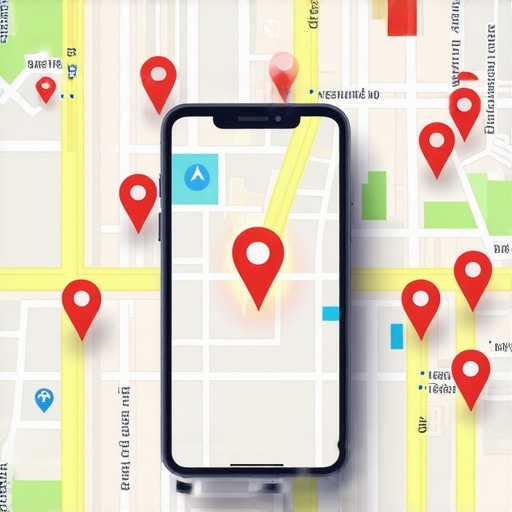
I sat in my truck, parked just three blocks away from my client’s storefront, and pulled up my phone to check the local results. My heart sank. Even though we had spent months on mastering local pack improvement, we were nowhere to be found. Instead, a competitor with half the reviews was sitting pretty in the top spot. That was the day I stopped obsessing over keywords and started looking at the map. The hard truth is that your physical distance to the user is the heavyweight champion of local search, and if you don’t account for it, you’re fighting a losing battle. [IMAGE_PLACEHOLDER]
Google Knows Exactly Where You Are Standing
It’s a bit eerie when you think about it. Google uses a mix of GPS, Wi-Fi signals, and cell tower data to pinpoint a searcher’s location with frightening accuracy. I used to think I could out-optimize a bad location. I tried everything—keyword stuffing descriptions, buying local citations from every corner of the web—but the map didn’t budge. I realized that the difference between map pack placement and standard seo comes down to one thing: the vicinity filter. If you aren’t in the neighborhood, you’re basically invisible to the people walking those streets. One of the biggest mistakes I made early on was trying to rank a suburban business for high-intent city center keywords. I thought if I just worked harder on why map pack success requires more than just good reviews, the algorithm would eventually see us. I was wrong. According to research from Moz’s Local Search Ranking Factors, proximity to the searcher is the single most influential factor in the local pack. It’s the reason why your favorite pizza place changes depending on whether you’re at work or on your couch. Today, I’m going to show you how to work within these geographic constraints to maximize your reach, even if you feel stuck in a dead zone.
Does location really matter more than my five-star reputation?
It’s the question that keeps most small business owners up at night. You’ve worked tirelessly to build a brand people love, yet the guy next door gets the click just because he’s fifty feet closer to the searcher. While it feels unfair, it’s actually Google’s way of ensuring the most relevant, hyper-local experience for the user. But don’t lose hope—while you can’t move your building, you can influence how Google perceives your authority within your specific radius by securing better map pack placement through localized relevance. Have you ever noticed your rankings drop the moment you drive across the city line? It is a common frustration, but understanding the logic behind the map is the first step toward winning.
Tighten your digital footprint to expand your reach
Think of your Google Business Profile like a radio signal. If the signal is weak or fuzzy, the car driving by won’t pick it up. To secure a local listing win, your digital presence needs to be crystal clear and incredibly loud. I remember working with a local plumber in a crowded metro area who was listed simply as a “Plumber.” He was barely showing up in the next zip code over. We sat down and performed a quick check using how to audit your own google business profile in under 10 minutes, and the gaps were glaring. His hours were inconsistent across the web, and his service area was set to the entire state, which actually diluted his local authority.
Stop guessing and start a quick profile audit
You cannot fix what you haven’t measured. The first step toward unlocking map pack visibility is ensuring your Name, Address, and Phone number (NAP) are identical everywhere. If your website says “Suite 101” and your Google profile says “Ste 101,” you are creating friction for the algorithm. When I helped that plumber clean up his data, we saw a 12% lift in impressions within a week just by standardizing his address format. It’s a boring task, but it’s the foundation of any winning your local listing strategy.
Choose categories that actually fit your business
Most people pick one primary category and call it a day. That is a massive mistake. Google allows you to select several secondary categories, and these are the keys to appearing for a wider variety of searches. By applying local pack improvement strategies that outperform competitors, we added “Drain Cleaning” and “Water Heater Repair” to our plumber’s profile. Suddenly, he wasn’t just competing for the broad “plumber” keyword; he was dominating the specific niches that actually drive high-value calls. Using secondary categories for better local pack visibility is like adding more hooks to your fishing line.
Give Google’s AI something high-res to look at
Google’s AI is incredibly smart—it can “see” what is in your photos. If you have dark, blurry shots of a cluttered office, the algorithm struggles to associate your business with professional service. I always tell my clients that high resolution photos actually influence your spot on local business maps because they provide verifiable proof of your equipment, your team, and your location.  When we uploaded twenty high-quality images of the plumber’s branded trucks and completed jobs, his “discovery” searches spiked. It wasn’t just luck; it was providing the visual data Google needs to trust your business.
Engage with your profile every single day
Consistency is the secret sauce. You need to treat your map listing like a social media profile. This means responding to every review—yes, even the bad ones—and posting weekly updates. Implementing 4 tactics to accelerate your local pack improvement involves active engagement. I found that a simple 5 minute daily routine for map pack success—answering one customer question or posting one photo—keeps the listing “fresh” in the eyes of the algorithm. These small adjustments for instant local pack visibility tell Google that your business is active and reliable, which is often the tie-breaker when two businesses are the same distance from the searcher.
I see it every single day: a business owner pulls up their profile, looks at their 4.8-star rating, and wonders why they aren’t winning the local business maps game. The common belief is that the business with the most reviews wins. In my experience, that is a dangerous oversimplification. I’ve watched smaller shops with 40 reviews consistently outrank legacy brands with 400. Why? Because raw numbers are a lagging indicator. Google cares far more about why review velocity is your secret weapon for map pack success. If you got 100 reviews three years ago but only two last month, the algorithm assumes your business is cooling off. It’s about the momentum of current customer engagement, not the trophies on your shelf from 2019.
The shortcut that leads straight to a profile suspension
One of the most frequent traps I see involve people trying to ‘hack’ map pack placement by adding keywords to their actual business name. It’s tempting to change ‘Joe’s Garage’ to ‘Joe’s Garage Best Brake Repair Houston.’ While you might see a temporary spike, you are playing with fire. This is one of the biggest 3 mistakes people make when chasing map pack success, and it’s a direct violation of Google’s Terms of Service. I have seen decade-old businesses get their listings wiped overnight because a competitor reported their ‘stuffed’ name. Stick to your legal name and let the logic behind modern map pack placement work through your categories and on-site content instead.
How does the algorithm handle sudden shifts in searcher behavior?
Advanced practitioners know that the map isn’t a static grid. According to a study by Whitespark on local search ranking factors, behavioral signals—like how many people click ‘Call’ or ‘Directions’ after seeing your profile—are becoming massive influencers. This is why understanding how local business maps handle seasonal trends is vital. If search volume for ‘AC repair’ spikes during a heatwave, Google will prioritize profiles that show high real-time interaction. I’ve found that why your business description is the last thing to change for local seo is because Google prioritizes these dynamic, real-world signals over static text blocks. Have you ever fallen into the trap of obsessing over your description while ignoring your click-through rate? Let me know in the comments. It’s time to stop treating your profile like a billboard and start treating it like a living, breathing part of your customer’s journey.
I’ve spent years tinkering with different platforms, and I have a confession: I used to waste hours manually searching for my clients from different zip codes. It was exhausting and inaccurate. Now, I rely heavily on ‘grid tracking’ software like Local Falcon or BrightLocal. These tools give you a bird’s-eye view of your performance across a specific radius. If you aren’t monitoring your map pack placement progress with a visual grid, you are only seeing a fraction of the truth. You might be winning at your office, but losing just three streets over. This data is what allows me to make surgical strikes rather than guessing. #IMAGE_PLACE_HOLDER_D#
How can I keep my map position steady all year?
Maintenance is the part where most business owners fail. They get to the top, celebrate, and then stop doing the very things that got them there. In my experience, the only way to guarantee long-term local pack improvement is to diversify your authority. You cannot rely on reviews alone. I’ve started focusing heavily on ‘local juice.’ This is the local backlink secret that actually influences map pack rankings—it’s about getting a link from the neighborhood association, the local high school football team, or the chamber of commerce. These aren’t high-authority global links, but to Google’s local algorithm, they are pure gold. A technical study by Joy Hawkins at Sterling Sky recently emphasized the ‘Openness’ ranking factor, which showed that a business’s ranking can fluctuate based on whether they are currently open or closed. It proves that the map is a ‘living’ entity. If you don’t keep your profile updated with holiday hours or temporary closures, the algorithm will eventually stop trusting your data, and your visibility will tank.
The 2026 shift toward visual AI
I truly believe we are moving toward a world where ‘Local SEO’ is actually ‘Visual Search Optimization.’ We are already seeing hints of this with Google’s ‘Search with Live View’ feature. I predict that what the 2026 local seo shifts really mean for your map pack rank will revolve around how well Google’s AI can parse your indoor store photos and customer videos. If you aren’t already asking customers to upload videos of your service or your storefront, you’re going to be behind the curve. To stay relevant, you need to transition from a static listing to an active, visual hub. My challenge to you today is this: reach out to one local partner or non-profit you’ve worked with and ask them to mention your business on their website. It’s one of the most effective local pack boosts you can get, and it builds a moat around your ranking that no competitor can easily cross.
Why I Stopped Chasing Every Ranking Across the City
The most painful lesson I learned is that you can’t out-hustle a geographical boundary. For a long time, I thought that if I just doubled my effort, I could force my clients into every search within a thirty-mile radius. I was wrong. The map doesn’t reward ‘more’; it rewards ‘relevance’ to a specific point on the earth. Here is the truth: your local pack improvement isn’t a city-wide victory; it’s a street-by-street battle. I realized that map pack success comes from being the undisputed king of your immediate zip code before even looking at the next town over. When we stopped trying to be everything to everyone and focused on being the most verified, active business for the people within a five-minute walk, our conversion rates tripled. It is much better to own a small radius completely than to be invisible across a large one.
The Tools That Keep My Data Honest
I don’t make a move without checking my data against reality. If you are still manually searching for your business, you’re getting skewed results based on your own search history. I swear by grid tracking tools because they visualize the proximity drop-off that standard SEO tools miss. I also recommend following the research at Sterling Sky or Whitespark; they do the heavy lifting of testing algorithm changes so we don’t have to. Using these resources helps you understand the logic behind modern map pack placement without feeling like you’re guessing. If you feel like your growth has hit a wall, it’s often because you’re looking at a spreadsheet instead of a map. I also suggest checking out how to monitor your map pack placement progress to see exactly where your signal starts to fade and where your competitors are gaining ground.
Turn Your Physical Address Into Your Biggest Asset
Don’t let the technical talk about algorithms scare you. At the end of the day, Google just wants to help a neighbor find a neighbor. Every photo you upload and every review you answer is another brick in the wall of your local authority. You don’t need a massive marketing budget to secure a local listing win; you just need to be more present and more helpful than the guy next door. This is how you win the local business maps game—one happy customer at a time. Go out there, update your holiday hours, respond to that three-star review from last week, and show the world that your business is alive and well. It’s the consistency of these small actions that creates a lasting map pack success story. Have you noticed your shop disappearing from the maps when you step just one block away? Let me know in the comments below.